

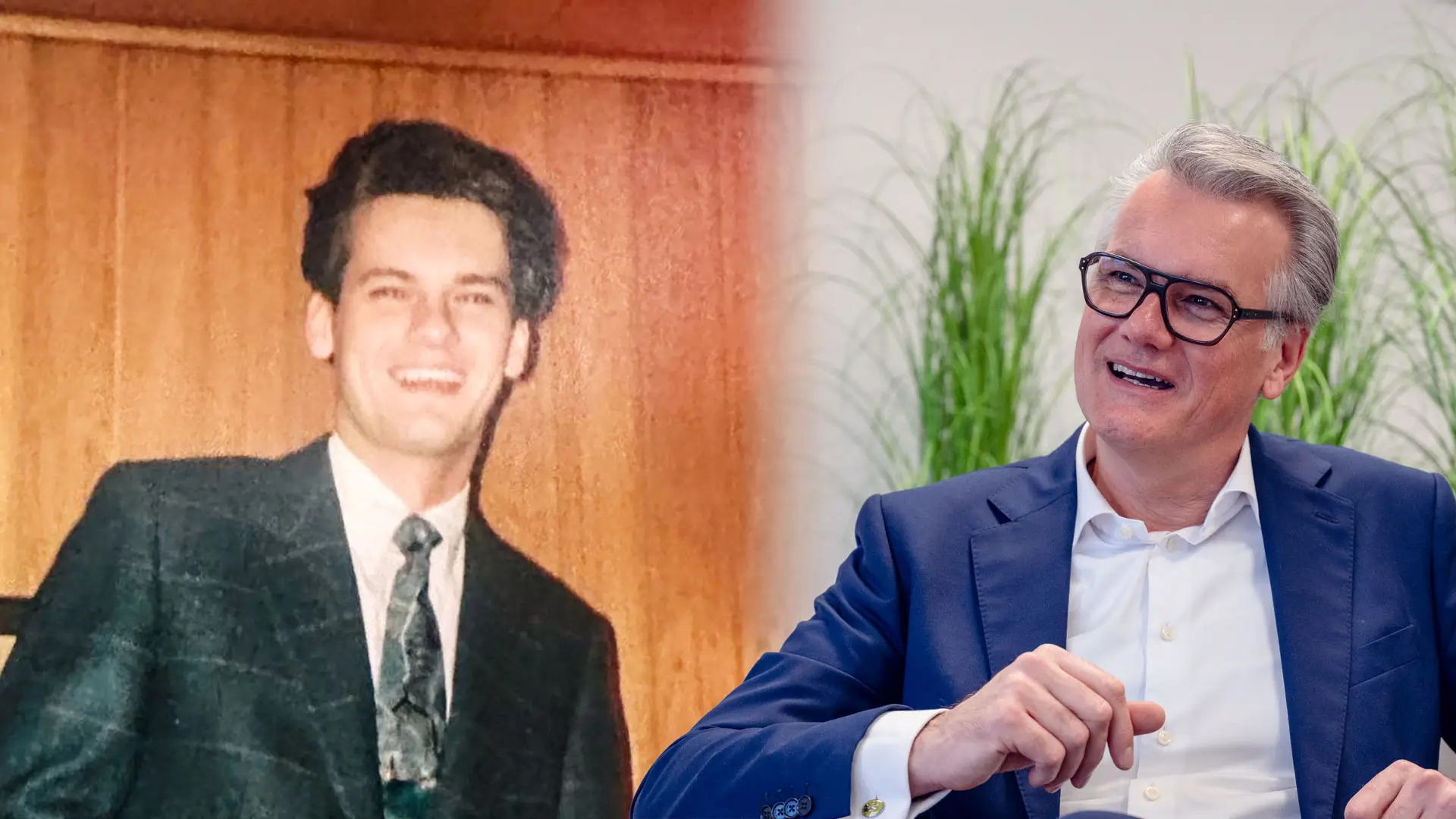

After completing the two years of my apprenticeship, during which I gathered insight across several areas of the business, I spent an additional year as a management trainee while continuing my studies. During that time, I worked in Inside Sales as the assistant to the Export Sales Manager for Asia.
After successfully graduating from VWA, I was offered a permanent position at Deloro. However, the offer fell short of my expectations, so I joined the Allgemeine Kreditversicherungs AG in a management trainee program and later moved to Bose GmbH, a manufacturer of speaker systems.
At Bose, a colleague and I developed and implemented a sales strategy for the company’s professional product line, helping to establish and grow that business segment focused on use in chains like Burger King or in large clubs, exhibition centers or hotels.
About a year after I had left Deloro, my former manager, Jürgen Kuffner, called me and asked whether I would be interested in returning to take on the role of Export Manager for Asia, Pacific, Africa. Given my strong interest in international business and different cultures, I did not want to miss that opportunity.
So, on September 1, 1995, I returned to Deloro – this time with full responsibility for a sales budget of approximately 10 million Deutsche Mark across a number of geographically distant and highly diverse markets.

My further career was shaped by changes taking place within the company, particularly the ownership change to a private equity investor in 1997. This has triggered the acquisition of businesses with operations in Italy and France.
Thanks to my language skills, I was asked to take a closer look at the newly acquired company in France. About one year later, the Group CEO approached me and offered me the position of Managing Director of the French business – which I accepted without hesitation. At the age of 29 years, I moved to the south of France to run an investment casting operation with around 150 employees.
I spent about six years in that role and successfully repositioned the company, reshaping its strategy on medical implants. These changes, combined with a bolt-on acquisition in 2005 for finishing and polishing of implants, strengthened the business and made it a market leader in Europe.

In 2006, the group’s new owner asked me to take over as Managing Director of the Koblenz operation while remaining President of the French company, focusing exclusively on its strategic direction. I therefore handed over the day-to-day management in France and returned to Koblenz.
Back in Koblenz, I had the pleasure to oversee a major investment program during my first years which was accompanied by a period of strong sales growth. The global financial crisis of 2008 brought this phase to a sudden halt. However, we recovered quickly, and the Koblenz site continued its international expansion through the acquisition of a company in Italy and the establishment of a new operation in India.
When our investor entered into discussions with the management team regarding a potential sale of the company to Kennametal in 2011, we actively supported the process. Ultimately, on December 1, 2012, the shares held by both the private equity investor and the management team of the Deloro Stellite Group were sold to Kennametal.
The subsequent integration into the corporate culture of Kennametal, a US listed company, was a fundamental change for Deloro, its employees, and its culture.
For me, it created the opportunity to join Kennametal’s European executive team and spent approximately three years in Schaffhausen, Switzerland. I was in charge of several business units, while continuing to oversee Deloro’s sales operations in Koblenz. Clearly, Deloro did not do well with the ownership change.
With the change of the Kennametal CEO, I seized the opportunity to demonstrate that Deloro’s integration into the corporate group was not contributing to its long-term success. As a result, I was asked to develop a strategic proposal for reshaping Deloro’s European businesses and positioning them for future growth.
I was ultimately asked to implement this proposal myself. Just two months after the new structure had been put in place, I was informed that the business had achieved a level of independence that made a divestiture from Kennametal feasible.
It soon became clear that my role would extend beyond supporting the sale process – I would be leaving Kennametal together with Deloro as part of the transaction.
After what was undoubtedly a challenging and eventful sales process, Madison Industries acquired Deloro on December 1, 2015. Since then, I have held the position of CEO for Deloro Group. After about 6 years under Madison ownership, they decided to divest the business, and I accompanied another sale process.
Also with our new owners, which acquired Deloro on February 1, 2022, I have the privilege to continue in this role. In addition, I was asked to take over responsibility for two other companies in the owner’s portfolio.

The most significant moment was helping Deloro regain its independence after the separation from Kennametal. After years as part of a large corporate structure, it was highly rewarding to lead the company into an independent future and build on its core strengths and capabilities together with a new owner.
The answer is not a single product or project. What I am proud of is the fact that, for decades and under very different and permanently changing ownership structures, Deloro has consistently generated the financial strength to fund its own development – and, in many cases, support other companies within the group. That strength has enabled us to provide secure jobs for our employees throughout more than 50 years of the company’s history, something that unfortunately can no longer be taken for granted in today’s business environment.

There have been far too many successes, projects, and milestones over the years to name them all. However, I would highlight the acquisition and successful development of Deloro Coatings in Italy, achieving nuclear industry qualification as one of the first suppliers in Europe, and the development of high-performance alloys – particularly in the years since Deloro regained its independence and has been able to focus entirely on its own strengths and capabilities.
Finally, I am particularly proud of the work we did to define and embed our core values – Courage, Credibility, and Respect. These principles have been at the heart of our company culture now for many years and continue to guide the way we work together.
Without a doubt, it was the family-oriented company culture: Including short decision-making paths, direct communication, and an emphasis on proactive, solution-oriented thinking and personal responsibility over rigid adherence to rules and regulations made Deloro a unique place to work.
Our employees are probably best positioned to answer that question though.

I hopefully still have a few years ahead of me, but it is an interesting question – and one that I genuinely think about. As you might know, I am responsible not only for Deloro Wear Solutions in Koblenz, but also for other companies within the Deloro Group. Each of these businesses is on its own journey, facing its own challenges, periods of strength, and critical times.
I want to be able to look back on a group of companies that is sustainably positioned – serving strong customers in strong and resilient markets – and making a meaningful contribution to a changing world through its products and services.

In a nutshell:

First and foremost, we need an even stronger focus on our customers and their needs. Satisfied customers are the foundation of any sustainable success.
Second, innovation will be critical – continuously adapting and improving our products and solutions to meet the evolving needs of our target markets.
Nothing is impossible. Think proactively, take initiative, make yourself visible, and don’t let hierarchies or middle management hold you back. Stay curious and get involved.
At the same time, don’t lose sight of the fact that there is more to life than work – maintaining a healthy balance is important, ideally from the very beginning.


 Jetzt anrufen
  Email verfassen
 e-Procurement
 Zum Shop
