


Materials with integrated wear protection
Full Metal Anti-Aging with long-term effects
250.000
kilogramms per year
We supply partners worldwide with materials for weld deposition, thermal spray, hot isostatic pressing and additive manufacturing, such 3D printing. The quantities vary from kilogram scale up to many tonnes. We not only adapt the material to your requirements, but also the delivery quantity.
20+
industries supplied
Deloro has been supplying very different industries since 1910. Therefore, we know industry-specific potentials for optimisation and can usually determine suitable filler materials at very short notice. And: If we don’t yet have a filler material that is 100% suitable, we can simply develop one – thanks to Deloro’s large technical expertise across the complete chain of research and development up to production.
500+
materials available
Our portfolio of materials has been consistently expanded since 1910. We not only orient ourselves on customer requirements, but also consistently observe regulatory, ecopolitical or application-related developments as well as innovations in research based on scientific applications. Worldwide.
Materials / alloys
Alloys for highest performance
At Deloro, you will find various alloys: Stellite, Tribaloy, Delcrome and many more for various application purposes. Your plus with Deloro: Using our own alloys, we have deep expertise regarding our own filler materials and their applications.
Deloro has extensive consulting expertise for alloys and filler materials. Why? We are our own user. The results from quality assurance measures and application experience will directly feed into research and development to optimise the respective alloy or filler material, as well as their implementation for different applications.
Deloro has been providing wear solutions in the form of high-performance alloys and hardfacings since 1910. The progressive loss of material from a component surface through mechanical wear, as a result of relative movement between surfaces and/or external media (sand, water,…) and usually exacerbated by thermal or chemical factors, affects the functionality of components. In a worst-case scenario, this can lead to longer-term failures of critical processes or the safety of users or consumers being compromised.
Corrosion is the degradation of a material resulting from an unfavourable interaction with its environment. It can be mitigated with Deloro alloys. Corrosion can affect the function of a component, or even a whole system. Corrosion protection is mandatory to protect critical processes.
Alloys from Deloro have excellent thermal stability and high-temperature oxidation resistance, because they contain elements such as nickel, cobalt, chromium, tungsten or molybdenum. This preserves strength, stability and functionality even (in certain cases) up to 1000 °C. It makes them ideal for use in combustion engines.
More about alloys
Deloro provides a broad range of alloys for many different industries, sectors and applications. But all of these with one intention: Protection against wear, corrosion and high temperatures, developed for critical processes of today and new technologies further into the future.
Hardfacing alloys and consumables
The Deloro materials are available as different types of product, which respectively match the coating and processing processes used by you. Deloro provides filler materials for PTA and laser deposit welding, thermal spray, additive manufacturing as well as processing by means of hot isostatic pressing (HIP) and sintering. The specified diameters might not be available for all alloys. We will be pleased to supply special sizes on request.

Powder
The powdered materials are atomized using vacuum, oxygen or water. This results in excellent sphericity, bulk density, and flowability, and meets the requirements for low oxygen content.

Wires
Stellite® cobalt-based flux-cored wires are available in the most common diameters from 1.2 to 3.2 mm and are supplied on 15 kg K300 standard spools or 25 kg reels.

Welding rods
Deloro materials in the form of rods are available in standard diameters from 2.5 to 8.0 mm. To meet diverse requirements, lengths are flexibly available from 350 mm to 4 m.

Electrodes
Deloro electrodes are available in typical standard diameters from 3.2 to 6.4 mm. The electrodes are supplied in lengths of 350 mm and are packaged in cartons weighing 5.0 kg. Electrodes with a diameter of 2.6 mm are available upon request.
Grain size and distribution in comparison
–
–
–
Matching size for
The particle size distributions shown are examples of possible delivery forms.
Special particle size distributions available upon request.
Special grain sizes available
All materials can usually also be supplied in customer-specific grain size distributions. We will be pleased to advise you on this with regard to application and base material.
Materials / Application
Types of application

Weld deposition
The rods used for WIG welding can also be used for acetylene oxygen weld processes. If correctly applied, a very low substrate dilution can be achieved in the layer.
MMA welding is a widespread weld deposition process. With this, an arc is generated between a shielded consumable electrode and the workpiece. The metallic core is melted by the arc and transferred to the weld pool as droplet.
The electrodes are supplied in lengths of 350 mm (14″) and boxes of 5.0 kg (approx. 11 lb) each.
With these arc welding procedures, the armouring wire is continuously guided through the welding torch into the arc by a coil, where it is welded and transferred to the workpiece. During submerged arc welding (UP welding), wire is used as weld deposition material. Here, flux powder flows on a mineral basis around the welding wire and is melted by the arc.
During powder welding, a specially constructed acetylene oxygen torch is used. The workpiece is heated by the torch. The powder is introduced into the gas flow from the integrated powder container and transferred to the workpiece by the flame.
The PTA process can be easily automated and provides a high degree of reproducibility of the weld positions. As the build-up weld materials are available in powder form, build-up welds can be produced from many different materials and material combinations with a large range of hardness and other properties.
During build-up with a laser, the laser beam is focused onto the workpiece using a laser beam using an optical arrangement, which heats up the surface. At the same time, armouring material is introduced into the laser beam in the form of powder or wire, and melted.
With additive manufacturing of metal parts based on a powder-pack method, such as selective laser melting, electron beam melting or the binder jet procedure, a special specification of the powder used for the procedures is required.
Tailored compositions and grain size distributions are possible.
Application by means of thermal spray
During plasma spraying, the powder is softened or melted in the plasma gas stream, through which the particles are also transferred to the workpiece.
For the availability of suitable filler materials for plasma spraying, we refer to our catalogue, which can be downloaded here.
In the HVOF process, a fuel gas oxygen mixture is burned in a combustion chamber. This results in a very hot gas under very high pressure. This gas is accelerated to supersonic speed through a nozzle. The coating material is injected into the gas beam in powder form, which melts partially in this process, and meets the workpiece surface at high speed. For the availability of powders for the HVOF process, we refer to our catalogue, which can be downloaded here.
Spray & fuse is a two-stage process, in which the powder alloy is applied first of all by means of flame spraying, and the layer surface is then surface-fused. During fusing, the layer is partially remelted and can be solidified again. For the availability of suitable filler materials for “spray & fuse”, we refer to our catalogue, which can be downloaded here.

Hot isostatic pressing (HIP)
Hot isostatic pressing is performed under high pressure and high temperatures. During this, powder-metallurgical materials can be solidified by means of HIP to form a solid, which usually exhibits better mechanical properties than conventionally created materials. For the availability of suitable powder for hot isostatic pressing, we refer to our catalogue, which can be downloaded here.

Additive manufacturing
Additive manufacturing, amongst others 3D printing, is a production process during which workpieces are built up layer by layer directly from digital data. Compared to subtractive processes (e.g. milling), material is added here instead of removed. In additive manufacturing with metals, metallic components are created through fusing or sintering of metal powder or wire layer by layer. The CAD model serves as a basis here for the build-up.
For the availability of suitable filler materials for additive manufacturing, we refer to our catalogue, which can be downloaded here.
Benefit from Deloro Consumables
Ob
- faster
- hotter
- more dense
- longer
- more safe
- more stable maintenance plan and
- less repairs or
- more economic
Just get in touch with us
We are glad to help.
Comparion of gas and water atomization
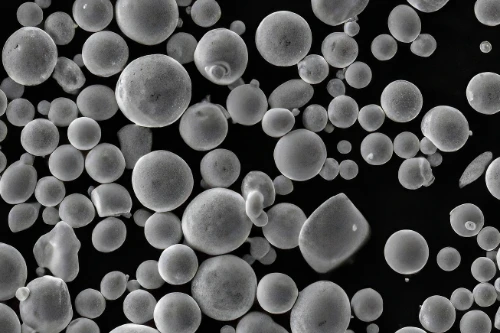
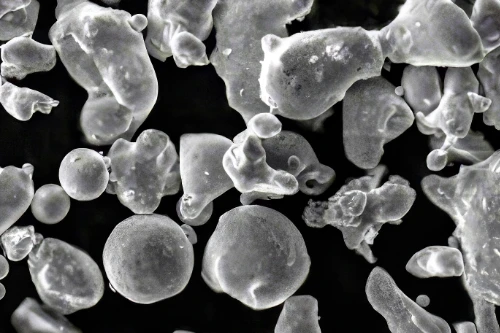
Left: Gas atomized metal powder
Right: Water atomized metal powder


 Jetzt anrufen
  Email verfassen
 e-Procurement
 Zum Shop
